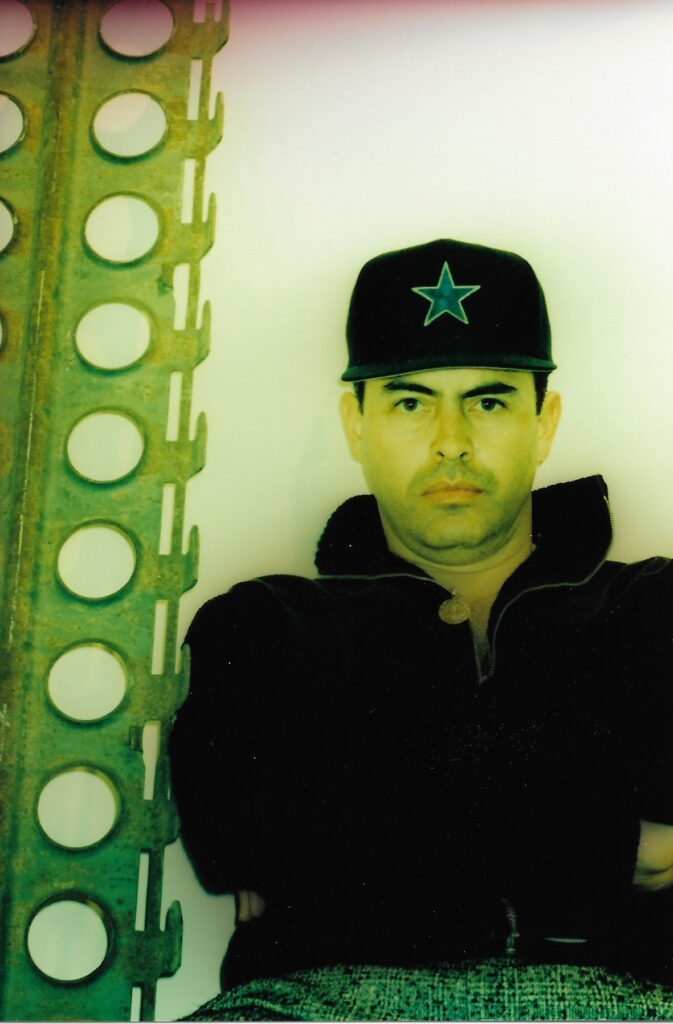
TORO LIBRIS | the subject of our first book: Armando Rascón
Born and raised on the US/Mexico border town of Calexico, California, Rascon’s childhood was informed by the language and symbolism of the nascent Chicano civil rights and cultural movements of the early 1970s. Rascón’s early works employed contemporary methods of research and analysis to examine the institutional construction of cultural repositories, archives, and information systems. As a young artist, Rascón established himself a pioneer in Chicanx conceptual art.
Departing Southern California for San Francisco in 1981 Rascón’s first body of work addressed AIDS activism. Early warning signs predominated his Folsom Street studio neighborhood (in the leather district), as the city’s Gay community erupted in a health threat of apocalyptic proportions –with the entire global community ultimately affected.
For five decades Rascón has merged video, computer animation, sound, interactive web-based art, language, curatorial methodology, borderlands decolonial discourse, queer and Xicanx identity into expansive media installation projects.
Web-AR codes activate the reader
epilogue
Thirty years after having penned the curatorial essay Xicano Progeny in 1994, Rascón closes this book with an epilogue entitled A Word for Xicanx Progeny.
The 1994 essay by Rascón was included in the catalogue of the exhibition, Xicano Progeny, curated by him and held at the Mexican Museum in San Francisco, California, in 1995. According to Rascón, one of the main objectives of Xicano Progeny was to examine the waning influence of Chicano ideology among the increasingly acculturated suburban Raza class (i.e. working-class neighborhoods in the United States with mostly Spanish-speaking residents) youth, as well as to define the key concerns of the new; what he calls, Revolutionary Generation (in reference to Chicano political movement). Rascón believes that central to achieving these objectives is promotion of identity selfhood and political empowerment, and the rejection of self-victimization among Chicanos. He also briefly discusses the work of each artist in the exhibition: Daniel J. Martinez, Lucia Grossberger-Morales, Marisa Hernandez, Iñigo Manglano-Ovalle, Elisa Jimenez, Ruben Ortiz, and Francesco Siqueiros.
Annotations Armando Rascón, an artist and curator, uses the framework of the Chicano Movement’s concept of “Aztlan” as a point of departure and historical reference to review and reassess the art of a younger generation of Latino artists in the 1990s. Not limiting himself to only Mexican-Americans or Chicano artists, Rascón includes Spanish, South American (Manglano-Ovalle and Grossberger-Morales), and Mexican (Siqueiros and Ortiz) artists who have made the United States their home and artistic focus. Unique to this exhibition and as delineated in his essay is Rascón’s concept of “Chicano” as an oppositional stance that is not narrowly linked to nationalist political terms, but instead by mirroring the the reality of contemporary communities caught in global migration. However, even though the essay questions what “Chicano” or “Latino” art is—especially after the Chicano Movement—it reasserts the importance of the Chicano Movement in the genealogy of this new generation of Latino artists.
” here at the AztlánLifeExtensionFoundation we hold firm to the belief that the meaning of life is contained in the struggle, and that true faith may be constructed daily through mediation + direct action, a proactive stance that holds the individual accountable to him or herself “. . . .[i]
[i] Armando Rascón, AztlánLifeExtensionFoundation. xicano.com, accessed February 1, 2026, http://www.xicano.com/border/home.html.
Claudia Zapata, from “Surfing Postcolonial Web 1.0: Armando Rascón’s Occupied Aztlán Database and xicano.com” their analytical and precisely written contribution to Proof of Concept.